Zero to One at Larger Companies
I spent eight years doing two startups back-to-back. After that, I landed at Brex, where I spent more than four years building or working on several products: two were complete zero-to-one builds, and two were mature products where I launched new sub-products underneath them.
Here's a screenshot of Brex's sidebar. The arrows mark the products I worked on during my time there:
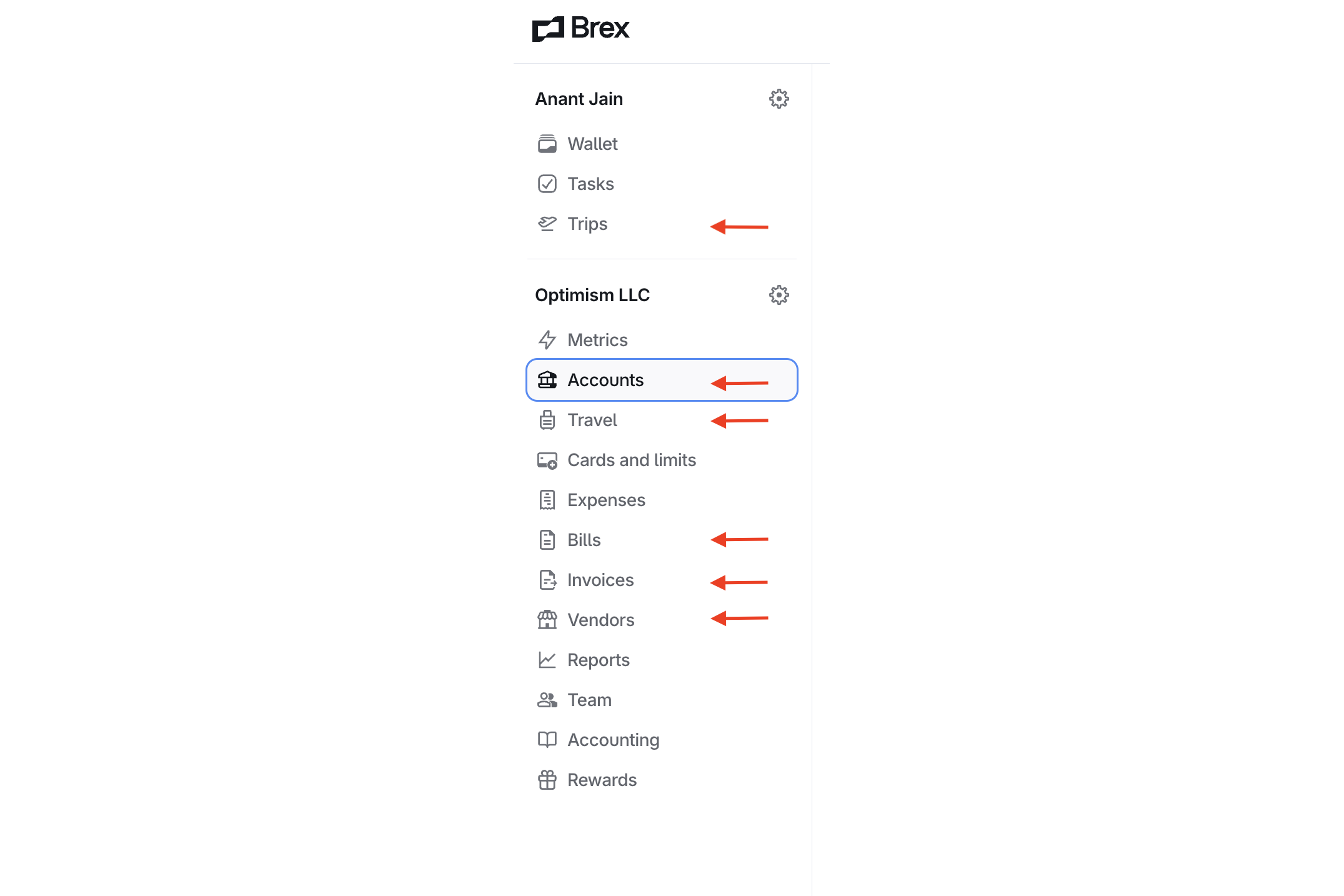
Each product area had its own zero-to-one moments, its own customers to win, and its own problems to solve.
Now I'm at Coinbase, building another zero-to-one product. Here's what I've learned: if you love building new things but want a break from the existential grind of startups, building zero-to-one inside a larger company might be exactly what you're looking for.
What you inherit
Inside the right larger company, you inherit a head start on some of the hardest parts of a startup: distribution, trust, infrastructure, and runway.
When we launched Brex Travel, we didn't have to cold-call enterprises and convince them Brex was legitimate. We already had enterprise customers using the rest of the Brex suite with competitors like Concur Travel or Navan for their travel needs. That customer base was immediately accessible. No brand-building. No trust-establishing. Just: here's a better product that works with your expense management suite.
You also get payment rails, compliance, support, funded runway without fundraising theater, and colleagues who've actually operated at scale.
What's still hard
You're not coasting. You typically have about a year to show real traction. Instead of monthly investor updates with growth charts, you're sending monthly updates to your CEO—who has similar expectations of exponential growth.
This is probably not the right fit if you're looking for a slower pace or better work-life balance. You're still fighting for survival. The context is just different.
What this isn't
Let me be direct: this doesn't compare to founding your own startup. Founding a company is categorically harder: more risk, more responsibility, and fewer safety nets. Building inside a larger company is a way for founders and builders to learn what scale and great engineering practices look like while still doing the kind of work that energizes them day-to-day.
The advantages also come with constraints: you're building within someone else's strategy, systems, and risk tolerance. The trade is straightforward: accept less autonomy in exchange for less existential risk, inherited distribution and infrastructure, and a chance to keep building from zero.
Who this is perfect for
- Startup people who want a breather without leaving the zero-to-one game
- Builders who love creating new things but aren't ready to start their own company yet
- Future founders who want to learn how larger organizations operate before going back out on their own
Come build with me
I'm currently building Coinbase Business, another zero-to-one inside the largest company I've ever worked at. We're still small, but we've seen significant momentum and growth through 2025. If this kind of work excites you, DM me on X (@anantjain).