Language Models are Few-Shot Learners (GPT-3)
Abstract#
Recent work has demonstrated substantial gains on many NLP tasks and benchmarks by pre-training on a large corpus of text followed by fine-tuning on a specific task. While typically task-agnostic in architecture, this method still requires task-specific fine-tuning datasets of thousands or tens of thousands of examples. By contrast, humans can generally perform a new language task from only a few examples or from simple instructions – something which current NLP systems still largely struggle to do. Here we show that scaling up language models greatly improves task-agnostic, few-shot performance, sometimes even reaching competitiveness with prior state-of-the-art fine- tuning approaches. Specifically, we train GPT-3, an autoregressive language model with 175 billion parameters, 10x more than any previous non-sparse language model, and test its performance in the few-shot setting. For all tasks, GPT-3 is applied without any gradient updates or fine-tuning, with tasks and few-shot demonstrations specified purely via text interaction with the model. GPT-3 achieves strong performance on many NLP datasets, including translation, question-answering, and cloze tasks, as well as several tasks that require on-the-fly reasoning or domain adaptation, such as unscrambling words, using a novel word in a sentence, or performing 3-digit arithmetic. At the same time, we also identify some datasets where GPT-3's few-shot learning still struggles, as well as some datasets where GPT-3 faces methodological issues related to training on large web corpora. Finally, we find that GPT-3 can generate samples of news articles which human evaluators have difficulty distinguishing from articles written by humans. We discuss broader societal impacts of this finding and of GPT-3 in general.
What You'll Learn#
This paper review explains how OpenAI created GPT-3, a language model that can perform new tasks without being specifically trained for them. Think of it as the difference between teaching someone a skill through extensive practice versus showing them just a few examples and having them figure it out. GPT-3 excels at the latter, which is a significant breakthrough in AI.
Overview#
Generative Pre-trained Transformer 3 (GPT-3) is an autoregressive language model introduced in May 2020 by OpenAI. "Autoregressive" simply means the model predicts the next word in a sequence by looking at all the previous words - similar to how autocomplete on your phone suggests the next word based on what you've already typed.
The paper focuses primarily on demonstrating GPT-3's capabilities rather than diving deep into technical architecture details. To fully appreciate GPT-3, it helps to understand the foundational concepts of language models and transformers. If you have basic familiarity with neural networks, here's a learning path that builds up to GPT-3:
- http://karpathy.github.io/2015/05/21/rnn-effectiveness/ - Introduction to recurrent neural networks (RNNs) and how they generate text
- http://colah.github.io/posts/2015-08-Understanding-LSTMs/ - Understanding LSTMs, a type of RNN that remembers long-term patterns
- https://distill.pub/2016/augmented-rnns/#attentional-interfaces - How attention mechanisms help models focus on relevant information
- Attention is All You Need paper - The paper that introduced transformers, the architecture GPT-3 is built on
- http://jalammar.github.io/illustrated-gpt2/ - A visual guide to GPT-2, GPT-3's predecessor
If you're completely new to machine learning, I recommend starting with fast.ai's MOOC, which provides an excellent foundation. My highlights from the paper are below.
Highlights#
The Evolution of Language Models#
The field of Natural Language Processing (NLP) has evolved through several phases:
- Early days: Models learned simple word representations (word vectors) and used them in custom architectures built for each specific task
- Middle phase: Recurrent Neural Networks (RNNs) created richer, context-aware representations, but still required task-specific architectures
- Current approach: Pre-trained transformer models like GPT-3 can be fine-tuned directly for any task, eliminating the need for custom architectures for each new problem
This evolution represents a shift toward more general-purpose, flexible AI systems.
Understanding Few-Shot Learning#
The paper demonstrates three key learning modes, illustrated in the diagram below:
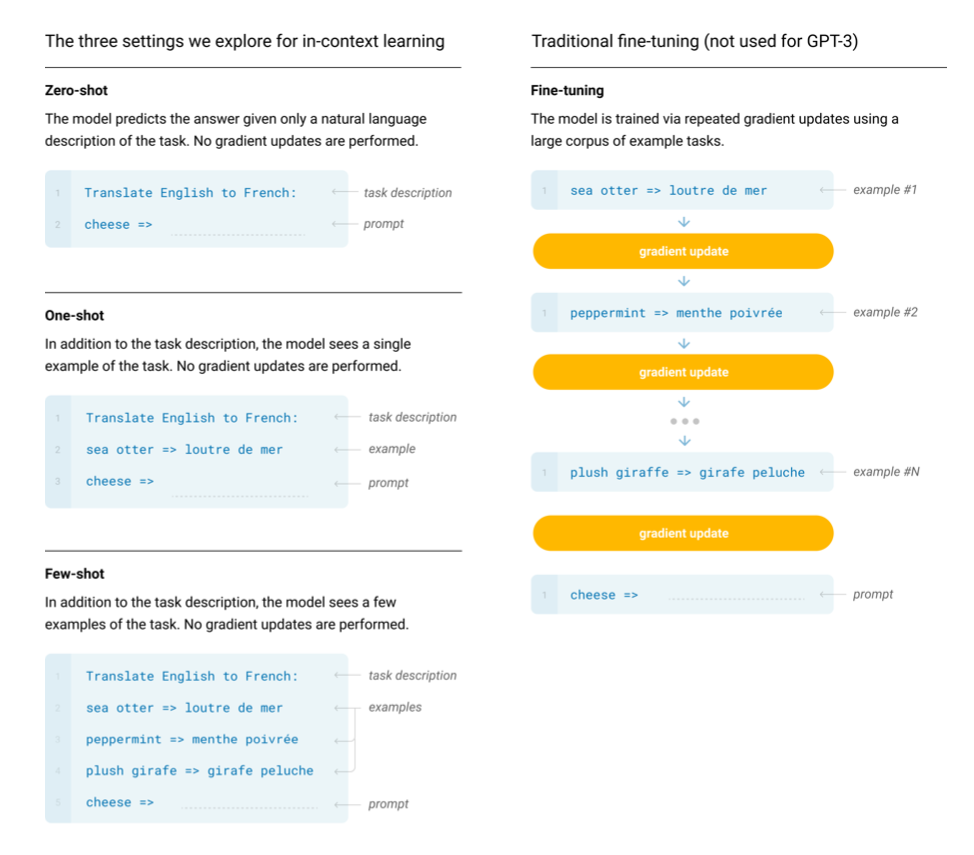
- Zero-shot: Give the model a task description with no examples. It attempts the task purely from the instruction
- One-shot: Provide one example of what you want, and the model infers the pattern
- Few-shot: Show the model a handful of examples, and it learns to generalize from them
The key finding: While zero-shot performance improves steadily with model size, few-shot performance increases much more rapidly. This means larger models are significantly better at learning from context without any parameter updates or training.
Model Architecture and Scale#
GPT-3 largely reuses the architecture from GPT-2 with one notable difference: it uses alternating dense and sparse attention patterns (inspired by the Sparse Transformer), which makes processing more efficient.
To understand how model size affects performance, the researchers trained 8 different versions ranging from 125 million to 175 billion parameters - that's a thousand-fold difference. GPT-3's 175 billion parameters make it 10 times larger than any previous dense language model. This massive scale is part of what gives GPT-3 its impressive capabilities.
Previous research suggested that with sufficient training data, larger models should perform better following a predictable mathematical relationship (a power law). This experiment confirmed that hypothesis across many different language tasks.
The Data Contamination Challenge#
A significant concern when training on massive amounts of internet data is data contamination: the model might have seen the test questions during training, which would make performance metrics misleading.
This is particularly problematic because:
- GPT-3 was trained on datasets about 100 times larger than GPT-2
- The training data includes huge portions of the internet (Common Crawl)
- Large models can memorize vast amounts of content
However, the good news is that GPT-3 doesn't significantly overfit (memorize) its training data, as verified by testing on a separate validation dataset that was carefully deduplicated from the training set.
Human vs. Machine: Can You Tell the Difference?#
As GPT-3 gets larger, an interesting phenomenon emerges: humans find it increasingly difficult to distinguish GPT-3-generated news articles from human-written ones. In fact, detection accuracy approaches random chance (50/50), even though people spend more time examining outputs from larger models.
This raises important questions about AI-generated content detection, which the authors identify as a crucial area for future research.
Broader Societal Impacts#
The paper addresses three key concerns about GPT-3's impact:
1. Potential Misuse Applications The technology could be used for harmful purposes like generating disinformation or spam.
2. Bias and Fairness
- Internet-scale biases: Because GPT-3 learns from internet text, it reflects the stereotypes and biases present in that data
- Gender bias example: The model more often describes women using appearance-focused words like "beautiful" and "gorgeous," while using a broader range of descriptive adjectives for men
- The path forward: The authors call for developing shared frameworks that connect the ethical, technical, and empirical aspects of reducing bias in general-purpose AI models
3. External Incentive Structures Competitive pressures and economic incentives around AI development need to be considered when deploying powerful models.
PDF#
Over the next few Saturdays, I'll be going through some of the foundational papers in Computer Science, and publishing my notes here. This is #21 in this series.